
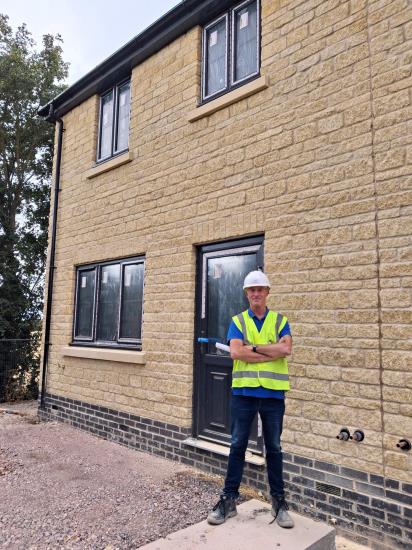
THE GOVERNMENT’S new approach to planning has kindled hope for more homes in rural communities says White Horse Housing Association Chief Executive Steve Warran.
It has shown more commitment to building more affordable and social housing through changes to the National Planning Policy Framework (NPPF) and has doubled down on the important role new homes play in keeping rural communities alive.
The NPPF sets out the Government’s planning policies for England and guides councils’ decision-making about what can be built and where.
“Planning policy can sometimes seem a long way removed from everyday life,” said Mr Warran, whose association has more than 450 homes in rural locations across Wiltshire, Swindon and Somerset. “But it has a direct impact on whether we can build the affordable homes that local people need.
“The revised NPPF gives greater recognition to how important affordable housing is and, crucially for us, agrees that rural communities need new homes if they are going to remain sustainable.”
He said this is important in villages across Wiltshire, Swindon and Somerset, where rising house prices force young people and families to move away from the communities where they have family, friends and jobs. Without affordable homes, villages struggle to keep the people who support schools, shops, businesses, services and community groups.
This month White Horse has taken on four new homes at Gaiger Homes’ Townsend Farmyard in Poulshot, near Devizes, and is set to take on eight more at Hills Homes’ development at Garden Close in Sutton Benger later in the year.
The new framework encourages more affordable homes to be built, including homes for social rent, and expects councils to do more to identify the different types of homes their communities need and plan to provide them.
Mr Warran said for White Horse, which specialises in providing affordable homes across rural Wiltshire and surrounding areas, this gives extra weight to schemes in communities where there is clear evidence that more homes are needed.
The reform also supports what are known as rural exception sites – small areas of land on the edge of villages where plans for housing would not normally be given planning permission, but where affordable homes can be built for local people.
“These sites have been incredibly important to us over the years,” said Mr Warran. “They can provide an opportunity to deliver a small number of much-needed homes in places where conventional development would not normally be allowed.
“But the key is that they have to meet a genuine local need. We work with communities, parish councils and landowners to find the right opportunities and make sure our homes are right for the area.”
The NPPF also encourages councils to identify smaller development sites, which could prove particularly useful for White Horse, where many schemes involve developments of between six and 20 homes.
Small sites and edge-of-village developments can often provide an answer in rural areas where large housing estates would be inappropriate.
The Government wants house builders to use brownfield –previously developed – sites in rural areas first, but agrees these sites alone won’t be enough to meet the country’s housing needs. This is important in rural areas where there are fewer brownfield sites. But this doesn’t mean the door is now open to building anywhere.
Good design remains important and new homes must respect the character of the communities where they built. Issues such as landscaping, biodiversity, accessibility and local infrastructure all continue to matter.
Mr Warran said: “We welcome the Government’s continued focus on increasing the supply of affordable and social housing and, importantly, its recognition that rural communities need affordable homes if they are to remain sustainable and vibrant.
“For us, this reinforces what we have always aimed to do, provide good-quality, affordable homes for people with a genuine connection to the villages in which we work.
“We hope the changes will make it easier to bring forward the small, well-designed schemes that are particularly important in rural communities, where housing need can often be significant but opportunities for development are limited.”